
Redvers ‘Red’ Stringer
Pilot. Engineer. Adventurer. A man for whom “that will do” rarely did.
Preparation before everything
Red’s story begins with the discipline of RAF fast-jet flying: briefing rooms, exacting preparation and the knowledge that small details can have large consequences. He developed a lasting respect for clear decisions, well-maintained equipment and a plan that could survive contact with reality.
Leaving the RAF in 2005, he turned that outlook towards engineering. The setting changed from cockpit to workshop, but the habits remained: arrive early, understand the problem and check the detail before committing yourself.
A lasting affection for aviation
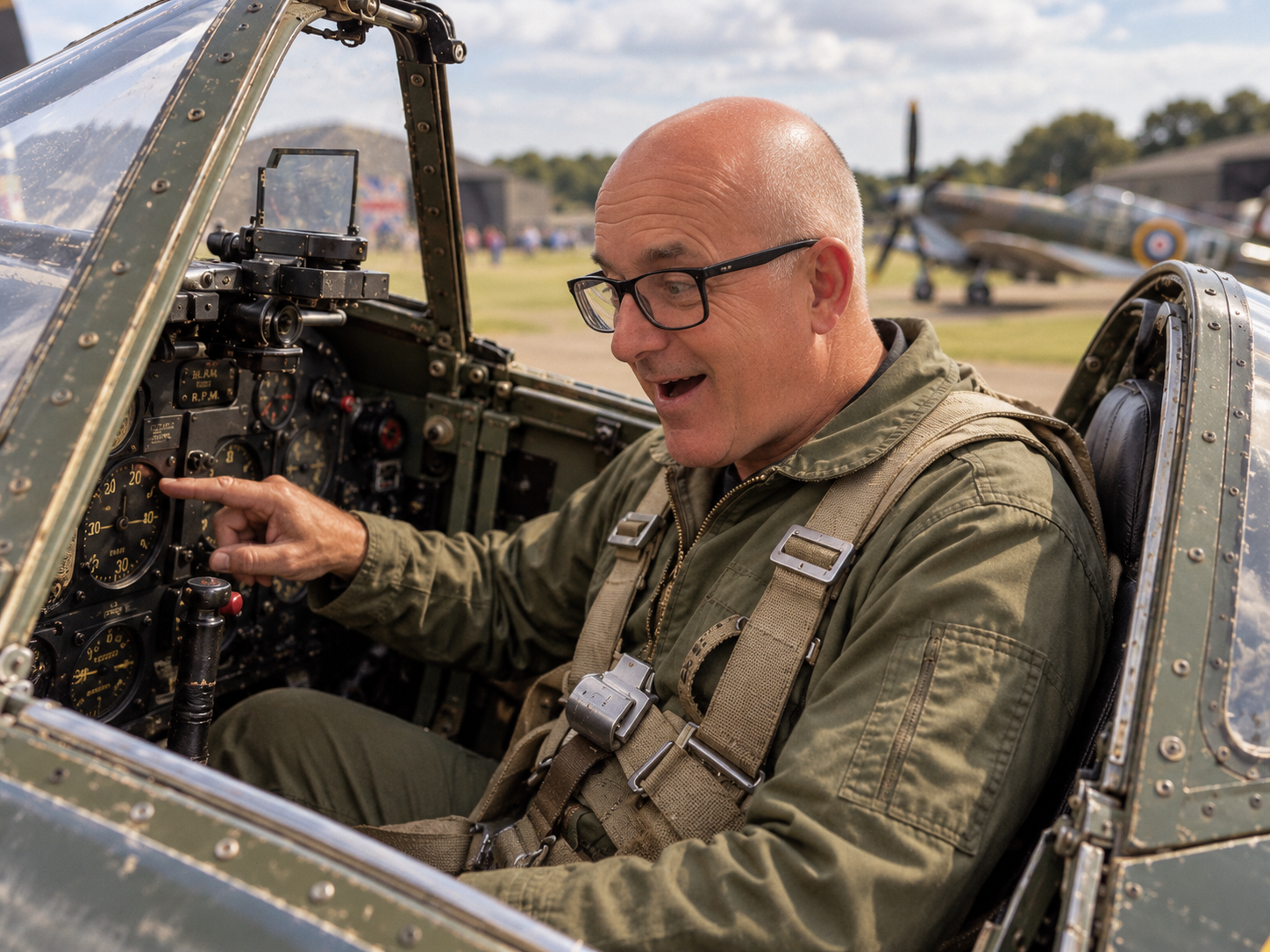
Leaving service did not diminish Red’s fascination with aircraft. The combination of elegant design, mechanical ingenuity and the discipline required to operate a machine well remained a source of inspiration. Historic aircraft held a particular appeal: engineering decisions made visible in every rivet, instrument and control.
The Spitfire scene in this scrapbook imagines a relaxed heritage-airfield visit, with Red enjoying a moment in the cockpit. It belongs to the later adventure album, rather than his RAF service record.
A workshop built around its founder
Near Canterbury, Red established Stringer Precision Engineering Ltd with the ambition of taking on work that rewarded ingenuity over volume. He was as comfortable talking through a stubborn component at the bench as welcoming visitors in a three-piece suit.
His preferred management style was direct, personal and occasionally accompanied by a pencil sketch on the nearest available sheet of paper. Apprentices were encouraged to ask questions; unsupported estimates received rather less encouragement.
There was, colleagues might have observed, a checklist for almost everything. The location of the checklist was sometimes a separate matter.
Across the Channel
A Channel swim occupies a proud place in the Stringer legend. Cold-water preparation, long training mornings and the unglamorous business of continuing when the next shore still looks impossibly far away suited his temperament.
He spoke of the experience less as a triumph over the sea than a lesson in breaking a very large problem into manageable strokes. It was an analogy that would later be applied to more than one difficult workshop project.
Above the clouds
Mountaineering supplied a different kind of challenge: weather windows, heavy packs and the patience to turn back when the mountain had other ideas. Red’s approach was methodical rather than theatrical, although the accounts over dinner could acquire a little additional altitude.
For him, a successful expedition was one in which everyone returned safely and the equipment was ready for the next one. The summit photograph was a welcome extra.

A challenge with a purpose
For Red, an adventure was more satisfying when it did some good beyond the finish line. His charitable work grew around that idea: turn a personal challenge into a shared effort, invite people to take part and make the cause more memorable than the individual doing the fundraising.
The company’s charity programme brought together sponsored swimming, mountain challenges, fundraising dinners and practical support for community projects. Red supplied the enthusiasm—and was usually the first to volunteer for the least comfortable part of the plan.
Swimming for a cause
The Channel-swim story became the centrepiece of his endurance fundraising. Preparation involved early starts, cold-water sessions and a supporting circle of friends who discovered that encouragement could involve considerably more standing on a windy beach than expected.
Smaller sponsored swims opened the idea to a wider group. Colleagues and friends could set their own distance, join a relay or help with the arrangements. Red valued the first-time participant as much as the experienced swimmer: the important thing was having a reason to get in the water.
Mountains, miles and teamwork
Walking weekends and mountain challenges offered a different way to contribute. Routes were planned around the abilities of the group, with time given to preparation, equipment and the less glamorous details that make an expedition work.
The fundraising was a shared undertaking. Some people walked, some organised transport and others encouraged sponsors back at home. Red’s insistence was that the contribution made behind the scenes mattered just as much as the photograph at the top.
An evening with a good story
Company fundraising evenings mixed supper, a raffle and an illustrated account of the latest adventure. Red would arrive with a carefully prepared talk, a collection of photographs and an optimistic estimate of how long it would take.
Aviation anecdotes and mountain mishaps provided the entertainment; the purpose was to bring people together around causes involving young people, family support and access to outdoor activities. The evenings became part of the social life of the company, with colleagues volunteering their time to make them happen.
Giving time as well as money
Red’s community interests also extended to practical mentoring. Workshop visits introduced young people to drawings, materials and the satisfaction of making something useful. He enjoyed explaining how a difficult job could be divided into smaller, manageable tasks.
Within the team, he encouraged experienced engineers to pass on their knowledge. A patient explanation, a borrowed tool or an afternoon spent helping someone gain confidence could be as valuable as a place on a sponsorship form.
The quiet work behind the event
Planning and follow-through were part of the commitment. Elizabeth coordinated the larger events, Claire kept the administration in order and workshop colleagues helped with everything from setting up tables to finding equipment at the last minute.
These efforts are remembered in the company story as a substantial part of Red’s life beyond engineering. The activities are invented for the parody; no real charity partnership, verified donation or audited fundraising total is claimed.
Away from the workshop
Not every chapter in Red’s scrapbook involves a checklist, a cold-water start or a difficult drawing. Time on the water offered a gentler change of pace: sunshine, good company and the chance to enjoy an evening without watching the clock.
Aboard a yacht with friends, the workshop suit gave way to an open-necked shirt and the conversation could wander well beyond engineering. Even Red, it seems, occasionally accepted that the best plan was simply to relax.

The final chapter
When Covid-19 disrupted business in 2020, Red’s first instinct was to find a workable plan. After a prolonged period of uncertainty, postponed projects and difficult decisions, the company closed in September 2021.
The machines fell quiet; the standards, stories and unmistakable sense of occasion remained. So did the Bentley: registration RED 1, a small concession to doing things with a little style.